What Is Content Marketing? A Plain-English Reference

Content marketing is a long-term strategy of creating and sharing free, useful content (blog posts, videos, newsletters, podcasts) to attract an audience and build trust before you sell anything. Instead of pushing ads at people, you pull them in by answering their questions and solving real problems.
It works because it earns attention rather than buying it. According to the Content Marketing Institute, content marketing costs about 62% less than traditional outbound marketing while generating roughly three times as many leads. That is why it has become a core channel for tech companies and small teams.
What Is Content Marketing?
Content marketing is a marketing strategy built on giving before asking. You create helpful material your target audience wants, publish it consistently, and earn their trust over time.
According to the American Marketing Association, content marketing is a long-term strategy focused on creating and sharing free, useful material to attract people and build trust before selling. That definition captures the heart of it: value first, sale later.
The content itself can take many forms. Blog posts, email newsletters, YouTube videos, podcasts, and social media updates all count. What they share is a purpose: help the reader, not interrupt them.
Content marketing is not the same as running ads. Ads rent attention. Content marketing builds an asset that keeps working long after you publish it.
The goals of content marketing usually fall into four buckets: brand awareness, more traffic, qualified leads, and lasting trust. A good content marketing strategy moves people from stranger to customer without a hard sell.
How Content Marketing Works
Content marketing works by earning attention instead of buying it. You publish content that answers real questions, and search engines and AI tools send interested people your way.
Pull Instead of Push
Traditional advertising pushes a message at people who did not ask for it. Think banner ads, cold calls, and pop-ups.
Content marketing does the opposite. It pulls people in. When someone searches for a problem, your blog posts and guides are waiting with an answer.
This pull model matters because buyers now research before they talk to sales. They read, watch, and compare on their own terms.
Value First
The rule is simple: give value before you ask for anything. Answer the question fully. Solve the problem for free.
When you do this, readers see you as a helpful expert, not a pushy seller. That goodwill compounds over time.
Value-first content also feeds search engines the depth they reward. Thorough, useful pages tend to rank better and stay ranked longer.
Building Loyalty and Trust
Consistency is what turns one reader into a loyal follower. Publishing on a steady schedule keeps you visible and top of mind.
Over time, that consistency builds trust. People come back, subscribe to your email newsletters, and share your work with others.
Trust is the currency of content marketing. When a trusted brand recommends its own product, the sale feels natural, not forced.
Types of Content Marketing (Quick Reference)
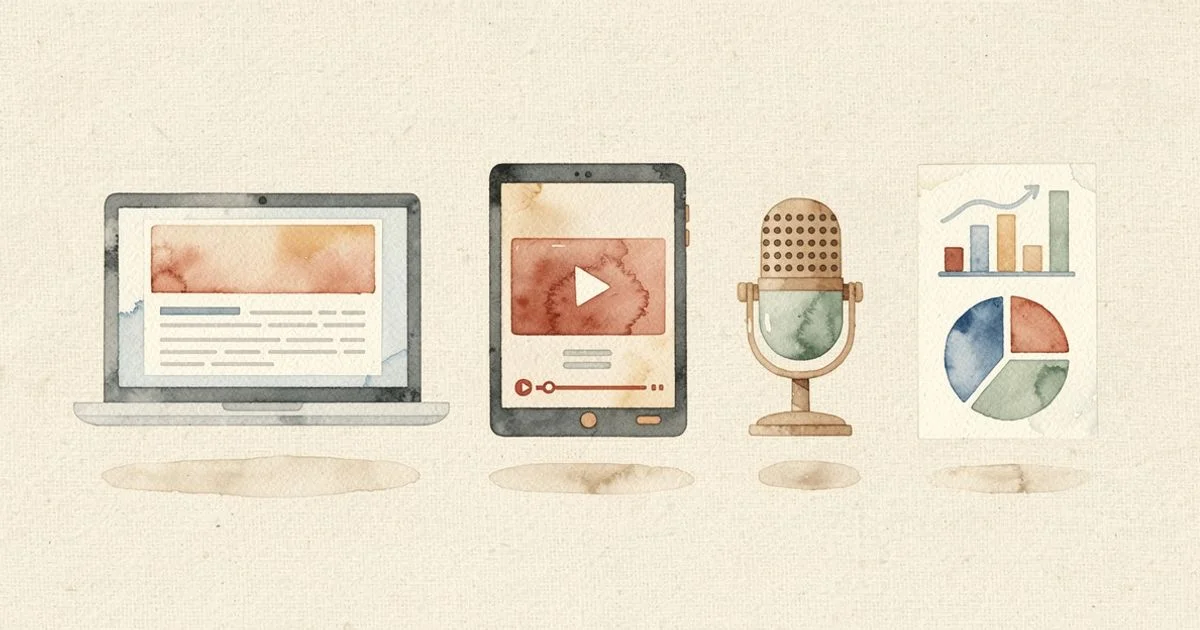
There are many types of content, but most fall into four groups. Use this quick reference to pick the right format for your audience.
| Type | Examples | Best For |
|---|---|---|
| Written | Blog posts, guides, email newsletters | SEO, deep answers, lead capture |
| Video | YouTube tutorials, demos, webinars | Teaching, product walkthroughs |
| Audio | Podcasts, audio guides | Loyalty, long-form conversation |
| Visual | Infographics, charts, social graphics | Quick facts, social media reach |
Written Content
Written content is the backbone of most content marketing. Blog posts and how-to guides answer the questions your audience already searches for.
Email newsletters keep subscribers engaged between visits. They are a direct line to people who already trust you.
Written content also does the heavy lifting for SEO. Search engines read text, so words are how you get found on Google.
Video Content
Video content explains things words cannot. A short demo can show your product faster than a page of text.
YouTube is the second-largest search engine in the world. A tutorial series there can attract viewers for years.
Video also builds a human connection. Seeing a face and hearing a voice speeds up trust.
Audio Content
Audio content, mostly podcasts, fits into busy lives. People listen while commuting, exercising, or cooking.
Podcasts build deep loyalty because listeners spend real time with your voice. That intimacy is hard to match.
You can also repurpose audio into blog posts, clips, and social media snippets. One recording feeds many channels.
Visual Content
Visual content makes complex ideas simple. Infographics turn data into something people share.
Charts and diagrams work well inside blog posts. They break up text and improve understanding.
Social media thrives on visuals. Strong graphics stop the scroll and lift brand awareness fast.
Content Marketing Examples
The best way to understand content marketing is to see it in action. Here are two content marketing examples that show the strategy at work.
A SaaS Blog That Answers Buyer Questions
Imagine a project management tool with a blog. Instead of writing about itself, it publishes guides on running better meetings and planning sprints.
Each post targets a question buyers already type into Google. The blog earns traffic from people with the exact problem the software solves.
Readers find the guide, trust the advice, and notice the product mentioned naturally inside it. Some sign up. That is content marketing for SaaS done right.
Because the posts keep ranking, they generate leads month after month with no extra spend. This is why published content delivers strong long-term ROI.
A YouTube Tutorial Series
Now picture a video editing app running a YouTube tutorial series. Each video teaches a skill, like color grading or adding captions.
Beginners search for these skills and land on the channel. The app appears in every tutorial as the tool being used.
Viewers learn something useful for free. When they are ready to buy, the app is the obvious choice because they already know it.
The series builds brand awareness, trust, and demand at the same time. That is the pull model working across video.
Related Concepts
Content marketing overlaps with other terms people mix up. Here is how it compares and connects.
Content Marketing vs. Traditional Advertising
Traditional advertising interrupts people to deliver a message. You pay for placement, and attention stops when the budget stops.
Content marketing earns attention with value. The content you publish keeps attracting people long after it goes live.
The cost difference is real. According to the Content Marketing Institute, content marketing costs 62% less than traditional marketing and generates about three times as many leads.
Content marketing vs. advertising is not always either/or. Many teams use ads to promote their best content and get the strengths of both.
How Content Marketing Supports SEO and GEO
SEO and content marketing are close partners. SEO is how search engines find and rank your pages, and content is what they rank.
What is SEO content? It is content written to answer a specific search query while staying genuinely useful. Content marketing produces that content at scale.
Content marketing vs. SEO is not a rivalry. SEO makes your content visible on Google, and content gives SEO something worth ranking.
There is also generative engine optimization, or GEO. This is optimizing content so AI tools like ChatGPT and Perplexity cite you in their answers.
In 2026, GEO matters more than ever because buyers ask AI tools before they open a search engine. Clear, fact-cited content is what these tools quote.
The through-line is consistency. To learn how to create a content strategy that works, you commit to publishing helpful content on a regular schedule and optimizing it for both search and AI.
FAQs
What Is Content Marketing in Simple Words?
It is publishing helpful free content, like blog posts, videos, or emails, to attract the right people and earn their trust so they buy from you later. You give value first, then sell. The idea is to be useful long before you ask for the sale, so buying from you feels like the natural next step.
What Are Examples of Content Marketing?
Common examples include blog articles, how-to guides, email newsletters, YouTube tutorials, podcasts, infographics, and social media posts. Each one answers a question your audience is already searching for. The best examples do not feel like marketing at all. They read like genuine help, with the product mentioned only where it fits.
What Do Content Marketers Do?
They plan a content strategy, research keywords and topics, create and optimize content, and track results like traffic, rankings, and leads. Increasingly they also optimize for AI answers in ChatGPT and Perplexity, not just Google. Their job is to turn business goals into content people actually want to read, watch, or hear.
Does Content Marketing Pay Well?
Yes. Content marketing roles in tech pay competitively, and the channel itself delivers strong ROI because published content keeps attracting traffic for months or years after you publish it. One good guide can generate leads long after the writer has moved on, which makes the work valuable to employers.
If you want your content marketing to attract traffic from Google, ChatGPT, and Perplexity without doing it all by hand, Zivooo gives you 30 research-backed blog posts a month, human editorial review before every publish, 40+ factor SEO and GEO optimization per article, custom AI images, and monthly high-DR backlinks. It is a practical option for founders and small teams who want steady organic growth on autopilot.
Author Details

Muntasir Rashid
Hello 👋 I’m Muntasir, founder of Zivooo and a content marketer with 20+ years of hands-on experience in marketing, growth, and building businesses.
I’ve spent the last two decades marketing my own ventures and helping clients grow through content, SEO, and digital marketing. Along the way, I’ve learned that the best strategies rarely come from theory, they come from testing, experimenting, failing, and figuring out what actually works.
Content marketing and growth are my forte. Here, I share practical insights, experiments, and lessons from the trenches covering SEO, GEO, AEO, AI search, and growth strategies for modern tech companies.
Keep learning, keep growing
We have more articles on similar topics to help grow your business.

12 Content Marketing Examples (and What Makes Them Work)
Content marketing examples like HubSpot, Spotify Wrapped, and GoPro reveal what actually works. See 12 real campaigns, why they succeeded, and what to copy.


B2B SEO Marketing: How Search Turns Into Pipeline
B2B SEO marketing targets high-intent keywords to reach corporate buyers through search.