What Is Long Format Content, and When Is It Worth Writing?

Last updated October 2026
Long format content is in-depth written, video or audio material that covers one topic thoroughly. It usually means 1,500+ words for an article, 10+ minutes for a video and 20+ minutes for a podcast episode. It is worth writing when the search intent calls for depth, not when a reader wants a one-line answer.
The payoff can be real. According to Semrush's State of Content Marketing report, articles of 3,000+ words get about 3x more traffic and 3.5x more backlinks than average-length posts. Still, length is the result, not the goal. Write as long as the question needs, then structure the page so Google and AI answers can lift a clear, citable passage from it.
How long is long format content, and is it worth it?
Long format content is worth it when your audience needs a full explanation, a comparison or a process before they act. It is not worth it for quick facts. The right question is not "how many words" but "how much does this reader need to finish the job they came to do?"
The short answer in numbers
Most marketers use these rough thresholds to decide whether something counts as long form:
- Written content: 1,500 words or more, with many in-depth guides running 2,000 to 4,000 words.
- Video content: longer than 10 minutes, such as tutorials, webinars and video essays.
- Audio content: 20 minutes or more, such as podcasts and interview series.
The baseline keeps rising. According to Orbit Media's annual blogger survey, the average blog post is now about 1,400 words, up from roughly 800 words a decade earlier. So a 1,500-word article no longer stands out on length alone. It has to stand out on depth, original data and structure.
What is long format content?
Long format content is any piece that explores a topic fully instead of skimming its surface. It answers the main question, the follow-up questions and the "what now" question in one place. The format can be text, video or audio, and the same idea often moves across all three.
Long form written content: blog posts, guides, whitepapers, case studies
Written long form content is the format most people picture first. It includes in-depth blog posts, how-to guides, white papers, research reports and case studies. These pieces earn search traffic because one thorough page can answer dozens of related questions a reader would otherwise search for separately.
White papers and case studies tend to serve readers later in the buying journey. A case study, for example, can pull numbers from CRM data to show what changed for a customer. That kind of proof is hard to fit into a short social media post, which is exactly why it belongs in a long piece.
Long form video content: tutorials, video essays, webinars
Long form video usually runs longer than 10 minutes. On YouTube, common examples include step-by-step tutorials, video essays, recorded webinars and documentary-style stories. Video marketing teams often treat the long version as the source and cut short clips from it for Facebook, Instagram and other social media channels.
Think about how you watch video during the day. You might scroll short clips on the go, then sit down at the end of the day and tune into something a little longer. Long form video fits that second moment, when a viewer has time and wants depth.
Long form audio content: podcasts and interview series
Podcasts and interview series are the audio side of long form. Episodes often run 20 minutes to well over an hour, and listeners choose them for the conversation, not a quick tip. A founder interview, for instance, can produce original quotes that later anchor a written article or a set of clips.
Why length alone does not make content long form
A 3,000-word page full of filler is not long form content. It is just long. What makes a piece long form is depth: real examples, specific steps, named sources and a clear answer to every sub-question. Padding to hit a word count usually hurts, because readers leave and search engines notice weak engagement signals.
Why long format content matters for Google and AI answers
The benefits of long form content come from coverage, authority and reuse. A thorough page gives Google more reasons to rank it and gives AI engines more clean passages to quote. These benefits compound over time, which is why long pieces sit at the center of most content marketing plans.
More search coverage from secondary keywords
One in-depth page can rank for hundreds of related queries. When you answer the main question plus the follow-ups, Google's systems can match the page to many phrasings of the same need. A short post usually ranks for a handful of terms at most, because it simply covers less ground.
Backlinks and authority build over time
Other sites link to pages they can cite with confidence. According to a content study by Backlinko and BuzzSumo, long-form content gets an average of 77.2% more backlinks than short articles. Semrush reports a similar pattern, finding that 3,000+ word articles earn about 3.5x more backlinks and 4x more shares than average-length posts of 901 to 1,200 words. Those links build domain authority that lifts your other pages too.
Evergreen value you can repurpose
A strong long piece often becomes evergreen content that stays useful for years with light updates. You can then repurpose it into email sequences, social posts, short clips and slide decks. One deep piece of research can feed a content calendar for your digital marketing team for weeks.
Getting cited in ChatGPT, Gemini and Google AI Overviews
AI answer engines pull passages, not whole pages. ChatGPT, Gemini and Google AI Overviews tend to cite pages that put a clear answer near the top, use clean headings and attribute stats to named sources. Long format content helps here only when each section can stand on its own as a quotable answer.
How long format content works
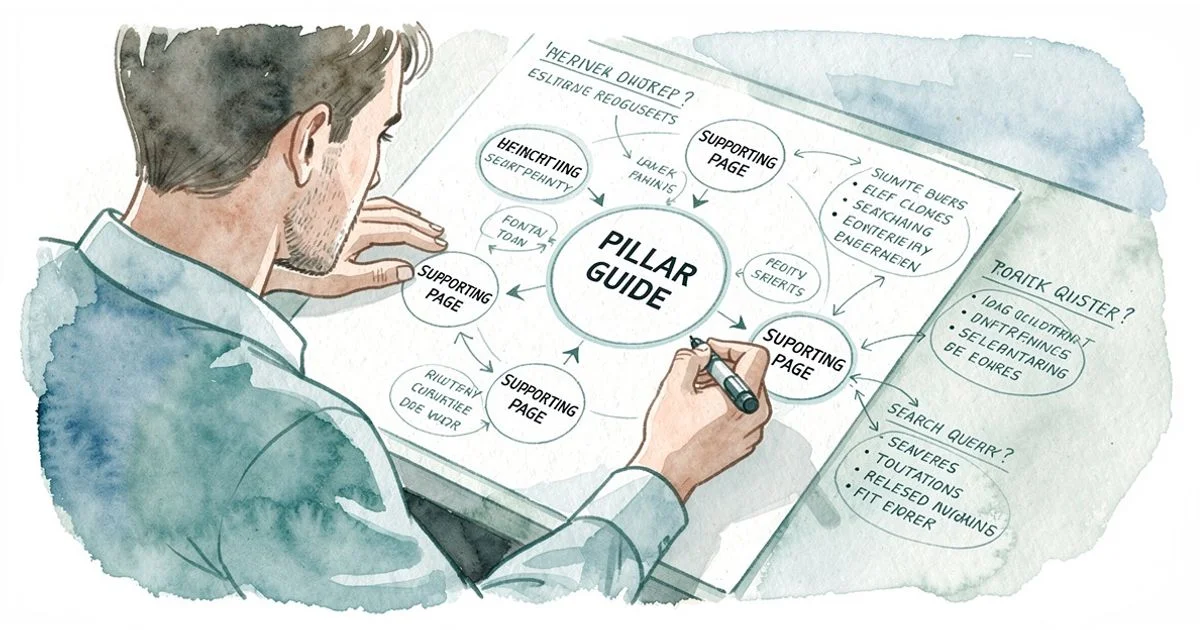
Long format content works when you start from the reader's goal and build outward. You define what the piece should achieve, match the intent behind the search, place it inside a topic cluster and structure it for skimming. Then you keep it fresh. Each step below explains the mechanism, not a checklist.
Matching search intent before you pick a length
Start by defining the goal of the piece. Is it meant to rank, convert, educate customers or support sales? Then study the audience and the query. If the top results for a keyword are short definitions, a 4,000-word guide is the wrong tool. If they are detailed comparisons, a 600-word post will not compete.
Audience research fills in the rest. Read sales call notes, support tickets and community threads to see which questions real people ask. That research tells you which sub-topics deserve a section and which ones you can skip.
Topic clusters: one pillar page, many supporting pages
Topic clusters group content around a core subject. One broad pillar page covers the topic at a high level, and supporting pages go deep on each sub-topic. Internal links connect them in both directions. This structure tells Google that your site covers a subject thoroughly, and it helps you pick a niche you can realistically own.
Structure that keeps readers and AI crawlers oriented
Good structure turns a long page into a set of short, findable answers. Use descriptive H2 and H3 headings, a table of contents, short paragraphs and lists where steps or options exist. Open each section with a lead sentence that answers its heading directly, so a reader or an AI engine can quote it without context.
Fact-checking belongs here too. Every stat should name its source, and you should check that the source actually says what you claim. Primary research, expert interviews and original data give AI engines something new to cite, which a rewritten summary of other articles cannot do.
Freshness: why long pages decay and need refreshing
Long pages slowly lose rankings as facts age, competitors publish newer pieces and search intent shifts. A refresh can mean updating stats, adding new sections, cutting outdated advice and improving internal links. Treat your best long pieces as products you maintain, not posts you publish once and forget.
Examples of long format content
The clearest examples of long form content solve one problem completely. Each of the formats below suits a different stage of the buyer journey, and each earns value in a different way: rankings, links, trust or conversions.
A SaaS pillar guide that ranks for hundreds of queries
A software company might publish a guide that explains a core concept in its market, from definition to setup to common mistakes. Because the guide answers so many related questions, it can rank for a wide spread of secondary keywords. It also becomes the hub of a topic cluster, linking out to narrower how-to pages.
A customer case study with original numbers
A strong case study tells a real story: the problem, the approach, the result and the lessons. Original numbers make it credible, so many teams pull them from CRM data or analytics with the customer's permission. Sales teams send these pages to prospects, and journalists sometimes cite them because the data exists nowhere else.
A long form YouTube tutorial cut into short clips
A creator might record a detailed tutorial on YouTube, then cut it into short clips for social media. The long video builds trust and watch time with viewers who want depth. The clips reach people scrolling on the go and point them back to the full tutorial when they have time to sit down and watch.
A data-led industry report that earns links
An annual survey or benchmark report is one of the most linkable assets you can make. Publications such as Search Engine Journal regularly cite original research, and so do bloggers writing their own guides. The Orbit Media blogger survey is a good example of this format, since writers quote its findings year after year.
A comparison page buyers read before they decide
Comparison pages explain how two or more options differ on features, price and fit. Buyers read them closely just before a decision, so they tend to convert well. A thorough comparison with a clear table and honest trade-offs earns more trust than a thin page that only praises one option.
Long format content vs short form content and other related formats
Long form vs short form is not a contest with one winner. Each format serves a different intent and a different moment in your reader's day. The comparisons below show where long format content fits next to short form content, pillar pages and evergreen content.
Long form vs short form content: a side-by-side view
| Factor | Long form content | Short form content |
|---|---|---|
| Typical length | 1,500+ words, 10+ minute video, 20+ minute audio | Under 1,000 words, short clips, social posts |
| Best for | Guides, research, comparisons, case studies | News, quick tips, announcements, social media |
| SEO role | Ranks for many keywords and earns backlinks | Answers narrow, quick-fact queries |
| AI answer role | Supplies citable passages and original data | Supplies short definitions |
| Effort to create | High: research, interviews, editing | Low to moderate |
| Lifespan | Often evergreen with refreshes | Often short-lived |
Long format content vs pillar pages
All pillar pages are long form, but not all long form pieces are pillar pages. A pillar page covers a broad topic and links out to supporting pages in a cluster. A long case study or white paper can be deep without acting as a hub. The difference is the page's job in your site structure.
Long format content vs evergreen content
Evergreen content stays relevant for a long time, whatever its length. A short glossary definition can be evergreen, and a long report on this year's trends may not be. Many long pieces become evergreen, but length describes depth while evergreen describes shelf life.
When short form content is the better choice
Short form content wins when the reader wants a fast answer: a definition, a price, a date or a quick how-to. It also suits social channels, where people browse in spare moments. Forcing depth onto a simple query wastes the reader's time, and search engines tend to rank the page that answers fastest.
What to do next: plan your first long format piece
Your first long format piece should come from evidence, not a hunch. The four steps below take you from topic to tracking. Together they form a repeatable content strategy you can run every month.
Pick a topic with proven search demand
Choose a topic that people already search for and that fits your niche. Look for queries where the ranking pages are detailed, because that signals the intent wants depth. Run a content gap analysis against competitors to find sub-topics they miss, since those gaps are your easiest wins.
Build a brief from the pages already ranking
Study the top results and list the sub-topics, questions and formats they share. Turn that list into a content brief with a target reader, a working outline, required sources and the one angle only you can add. Plan where primary research fits, such as a customer interview, a survey or your own product data.
Write, optimize and publish on a schedule
Write the draft from the brief, putting a direct answer in the first paragraph. Optimize headings, internal links and stat attribution, then fact-check every number against its source. Put the piece on an editorial calendar with a steady publishing cadence, because consistent output builds topical authority faster than random bursts.
Track rankings and AI visibility after launch
After launch, track keyword rankings and clicks in Google Search Console. Also check whether ChatGPT, Gemini and Google AI Overviews cite the page for its target questions. If rankings stall or citations never appear, revisit the opening answer, tighten weak sections and add fresher data.
FAQs
How many words is long format content?
Most marketers treat 1,500 words or more as long form for written content, and many in-depth guides run 2,000 to 4,000 words. The right length is whatever fully answers the query. Check what the top-ranking pages cover before you set a word count target, then aim to cover more ground, not more filler.
What is considered long form video content?
Long form video usually runs longer than 10 minutes. Tutorials, video essays, webinars and documentary-style stories on YouTube are common examples. Teams often cut these long videos into short clips for social media, so one recording feeds several channels and sends viewers back to the full version.
Is long form content better for SEO?
Often, yes, because a thorough page can rank for many secondary keywords and tends to earn more backlinks. But it only wins when the search intent wants depth. A quick factual query is better served by a short, direct answer, so match the format to what the searcher actually needs.
Does long form content get cited in AI answers?
It can, if it is structured well. ChatGPT, Gemini and Google AI Overviews tend to cite pages with a clear answer near the top, specific stats with named sources and clean headings. Depth helps most when each section can stand on its own, so an AI engine can quote one passage without the rest of the page.
Should I make both long form and short form content?
Yes for most teams. Use long form content to build authority and capture search demand. Then repurpose it into short posts, clips and emails that send people back to the full piece. The long piece does the heavy lifting, and the short pieces spread it.
What is the 80/20 rule for blogging?
The 80/20 rule for blogging has two common readings. One says to spend about 20% of your effort creating a post and 80% promoting it. The other says 80% of your content should help readers and only 20% should promote your product. Both push you toward fewer, better pieces that you actually distribute.
What are the 5 C's of content marketing?
Versions vary, but a common set is clarity, consistency, creativity, credibility and connection. Clarity means one clear message. Consistency means a steady voice and schedule. Creativity makes the piece memorable, credibility comes from sourced facts and connection keeps the focus on the reader. Long format content tests all five at once.
Conclusion: write for depth, not for word count
Long format content earns traffic, links and AI citations when it fully answers a question that deserves depth. The word count follows from that work, not the other way round. Match the intent, build clusters, structure every section so it stands alone, back each claim with a named source and refresh your best pages as they age.
If you want to plan, write and track long format content that ranks in Google and gets cited in AI answers, Zivooo gives you keyword and AI prompt research, competitor-based content plans, a live editor scoring 40+ SEO, GEO and AEO factors, scheduled publishing, and AI visibility tracking. It is a practical option for marketers and founders who want depth without a subscription.
Sources cited in this article
- Semrush, State of Content Marketing report: traffic, shares and backlinks for 3,000+ word articles compared with average-length posts.
- Backlinko and BuzzSumo content study: backlinks earned by long-form content compared with short articles.
- Orbit Media, annual blogger survey: average blog post length and how it has changed over the past decade.
WRITTEN BY

Muntasir Rashid
Hello 👋 I’m Muntasir, founder of Zivooo and a content marketer with 20+ years of hands-on experience in marketing, growth, and building businesses.
I’ve spent the last two decades marketing my own ventures and helping clients grow through content, SEO, and digital marketing. Along the way, I’ve learned that the best strategies rarely come from theory, they come from testing, experimenting, failing, and figuring out what actually works.
Content marketing and growth are my forte. Here, I share practical insights, experiments, and lessons from the trenches covering SEO, GEO, AEO, AI search, and growth strategies for modern tech companies.
Keep learning, keep growing
We have more articles on similar topics to help grow your business.

SEO Keyword Usage: How to Place Keywords Without Stuffing
SEO keyword usage means placing one primary keyword in your URL, title, H1, and intro, then supporting it with variations. Learn how to do it without stuffing.


Why Is Content Marketing Important? How It Earns Customers
Content marketing is important because it builds trust, drives organic traffic, and generates 3x more leads at 62% less cost than traditional marketing.