SEO Frequently Asked Questions: What People Ask and Why

Last updated October 2026
SEO frequently asked questions are the handful of questions people ask before they trust SEO with their budget. Most of them come down to five: what SEO is, how it works, how long it takes, what on-page, off-page and technical SEO mean, and how organic search differs from paid ads.
The honest answer on timing is months, not weeks. According to Google Search Central, most SEOs need four months to a year to help a business implement improvements and see potential benefit. Anyone who promises page one in a week is guessing.
An SEO FAQ can also mean an FAQ page or section written to answer those questions directly. That kind of page helps you rank for long-tail queries and get cited in Google AI Overviews and ChatGPT. Google narrowed FAQ rich results in 2023, so the value now comes from clear answers, not from the rich snippet.
What are the SEO questions people ask most?
The short version: five questions cover most of SEO
The most common questions asked about SEO repeat across every audience. Founders, marketers and small business owners ask nearly the same things, in nearly the same words. If you can answer these five well, you have covered most of what a buyer wants to know.
- What is SEO? The basic definition and why it matters for a business.
- How does it work? How Google finds, stores and ranks pages.
- How long does it take? The realistic timeline before results show.
- What are the types of SEO? On-page, off-page and technical SEO.
- Organic or paid? The difference between organic and paid search.
Behind those five sit dozens of smaller questions. According to Act-On, its SEO FAQ answers 31 of the most common SEO questions. That number shows how many distinct questions buyers bring to SEO, even when the core list stays short.
Where these questions come from: PAA, AI answers and sales calls
You can see these questions in three places. The first is the People Also Ask box in Google, which lists related questions under many searches. Each one you click opens more, so the box works like a live map of what people want to know.
The second is AI answers. People now type full questions into ChatGPT, Gemini and Google AI Mode, and the prompts read like real conversation. The third source is your own sales and support calls, where buyers ask the same questions again and again in plain language.
What is an SEO FAQ?
Meaning 1: the common questions people ask about SEO
The first meaning of an SEO FAQ is simply a list of common SEO questions and answers. It covers SEO basics such as what search engine optimization is, how rankings work and why some pages beat others. This is the version a beginner looks for when they want a quick primer.
These questions also shape how agencies, a typical SEO company and in-house teams explain their work. A buyer asking "what does an SEO service include?" wants the same plain answers. Good answers build trust and authority before any sales call happens.
Meaning 2: an FAQ page or FAQ section written to rank and get cited
The second meaning is a page built for search. This is an FAQ page or FAQ section on your own site that answers questions your buyers ask, written so Google can rank it and AI tools can quote it. It can live on its own URL or sit at the bottom of a product or blog page.
A strong FAQ page pairs each question with a short, direct answer. It uses the words searchers use, not internal jargon. When it works, it pulls in long-tail traffic and gives AI engines a clean passage to cite.
What an FAQ page is not: a dumping ground for every keyword
An FAQ page is not a place to stuff every keyword you found in keyword research. Fifty thin questions with one-line answers help nobody. Google can tell when a page exists only to catch queries, and readers leave fast.
Keep each question real, and keep each answer useful. If a question deserves a full article, write the article and link to it. The FAQ should answer the question first, then point to depth where it helps.
Why SEO FAQs matter for Google and AI answers
Question-shaped queries match how people search and prompt
People search in questions more than ever. They type "how long does SEO take" instead of "SEO timeline." In AI tools, they write full sentences and follow-ups. A page shaped around questions matches that behavior directly.
This matters because search intent sits inside the question itself. "What is SEO" signals a learner. "SEO company near me" signals a buyer. When your headings mirror the question, Google and AI engines can match intent with far less guesswork.
Benefits of FAQ pages for long-tail traffic and featured snippets
The main benefits of FAQ pages are long-tail reach and snippet eligibility. Long-tail keywords are longer, more specific phrases with lower volume each. Together they add up, and they usually carry lower keyword difficulty than short-tail terms like "SEO."
Short, direct answers also suit featured snippets. Google often lifts a two to four sentence passage that answers a question cleanly. An FAQ format gives you many chances at that box without writing a separate page for every query.
Why AI Overviews, ChatGPT and Gemini lift short, self-contained answers
AI answer engines build responses from passages. They prefer text that makes sense on its own, without needing the paragraph above it. A self-contained answer that names the subject and states the fact is easy to quote.
That is why FAQ pages tend to show up in AI Overviews and ChatGPT citations. Each answer already looks like what the engine wants to return. This is the core idea behind answer engine optimization, sometimes called AEO, and it overlaps heavily with SEO and GEO.
What changed when Google limited FAQ rich results
FAQ rich results used to show expandable questions directly under a listing. Many sites added FAQPage schema just to get that extra space. That shortcut no longer works for most sites.
According to Google Search Central, in August 2023 Google limited FAQ rich results to well-known, authoritative government and health websites. For everyone else, the payoff now comes from rankings, snippets and AI citations, not the dropdown in search results.
How SEO FAQs work in search and AI answers
How search engines crawl, index and rank a question and its answer
Search engines work in three steps. First, Google sends crawlers to crawl the web and discover pages through links and sitemaps. Then it reads each page and stores it in an index, a huge library of content. Finally, it ranks indexed pages when someone searches.
For an FAQ, each step matters. The page must be crawlable, which is a technical SEO job. Its questions must render as real text, not hidden scripts. And its answers must earn a rank through relevance, quality and the links pointing to the page.
Matching search intent with one question per answer
Search intent is the reason behind a query. It might be to learn, compare, buy or find a specific site. Each question on your FAQ should serve one intent, and each answer should resolve it.
When you bundle three questions into one answer, you blur the intent. Google and AI tools then struggle to decide which query the passage answers. One question, one answer keeps the match clean.
Where FAQPage schema helps and where it no longer shows in results
FAQPage schema is structured data that labels questions and answers in code. It still tells search engines exactly what each pair is. That clarity can help machines parse the page, even when no rich result appears.
What it no longer does, for most sites, is create the visible dropdown in Google. So treat the schema as a helpful label, not a ranking lever. The words on the page still do the real work.
How answer length and fact-checkable claims affect citations
Answer length shapes whether a passage gets lifted. Two to four sentences is usually enough to state the answer and one supporting point. Longer blocks often get trimmed or skipped.
Fact-checkable claims help too. A sentence that names its source, like Google Search Central, is easier for an AI engine to trust. Vague claims such as "SEO is very effective" give the engine nothing to verify, so they rarely get cited.
Examples of SEO FAQs that answer real questions
The examples below follow the format that works for snippets and AI answers. Each answer runs two to four sentences, opens with the direct answer and adds one useful detail.
What is SEO and how does it work?
SEO, or search engine optimization, is the practice of improving your website so it ranks higher in unpaid search results. It works by helping search engines crawl, index and understand your pages, then showing that your content best answers a query. Rankings depend on relevance, page quality, technical health and links from other sites.
How long does SEO take to work?
According to Google Search Central, most SEOs need four months to a year to implement improvements and see potential benefit. New sites and competitive keywords usually sit at the longer end. Fixes to pages that already rank can show movement much sooner.
What are the three pillars of SEO: on-page, off-page and technical SEO?
On-page SEO covers the content and HTML of a page, such as titles, headings and how well the text answers a query. Off-page SEO covers signals from elsewhere, mainly links, reviews and brand mentions. Technical SEO covers site speed, crawlability, indexing and mobile usability, so search engines can read your pages at all.
What is the difference between organic and paid search?
Organic search results are the unpaid listings Google ranks by relevance and quality. Paid search results are ads you bid on, usually charged per click. Paid traffic stops when spending stops, while organic traffic keeps flowing after the work is done.
Does duplicate content get penalized?
In most cases, no. Google does not usually penalize ordinary duplicate content, but it picks one version to show and filters the rest. The real problem is wasted visibility, so use canonical tags and unique copy where pages overlap.
SEO FAQs vs related concepts
FAQ page vs knowledge base vs help center
These three formats often get confused. An FAQ page answers the most common questions briefly, often before someone buys. A knowledge base holds deeper articles on how a product works. A help center bundles the knowledge base with support tickets, chat and contact options.
| Format | Main purpose | Typical reader | SEO role |
|---|---|---|---|
| FAQ page | Short answers to common questions | Prospects and new users | Long-tail queries, snippets, AI citations |
| Knowledge base | Detailed how-to articles | Existing users | Product and feature queries |
| Help center | Support hub with contact options | Customers with problems | Branded support queries, customer retention |
SEO vs GEO vs AEO
SEO focuses on ranking in search results like Google. GEO, or generative engine optimization, focuses on getting your brand cited in AI answers from tools like ChatGPT and Gemini. AEO, or answer engine optimization, focuses on writing answers that featured snippets and AI tools can lift directly.
In practice, SEO and GEO share most of their foundations. Pages that rank and answer clearly tend to get cited. The difference is mostly in what you measure: rankings for SEO, mentions and citations for GEO.
Featured snippets vs AI Overviews vs People Also Ask
Featured snippets show one extracted answer at the top of Google, with a link to the source. AI Overviews generate a summary from several sources and cite a few of them. People Also Ask shows a list of related questions that expand into short answers.
All three reward the same habit: a clear question followed by a direct answer. An FAQ section gives you a shot at each one from the same page.
Organic search vs paid search (PPC)
Organic and paid search often appear on the same results page, but they behave differently. Organic results cost time and content, then keep working. Paid search costs money per click and delivers traffic right away, then stops when the budget ends.
Many businesses use both. Paid search tests which keywords convert, and SEO builds lasting visibility for the winners. The two together cover short-term needs and long-term growth.
What to do next
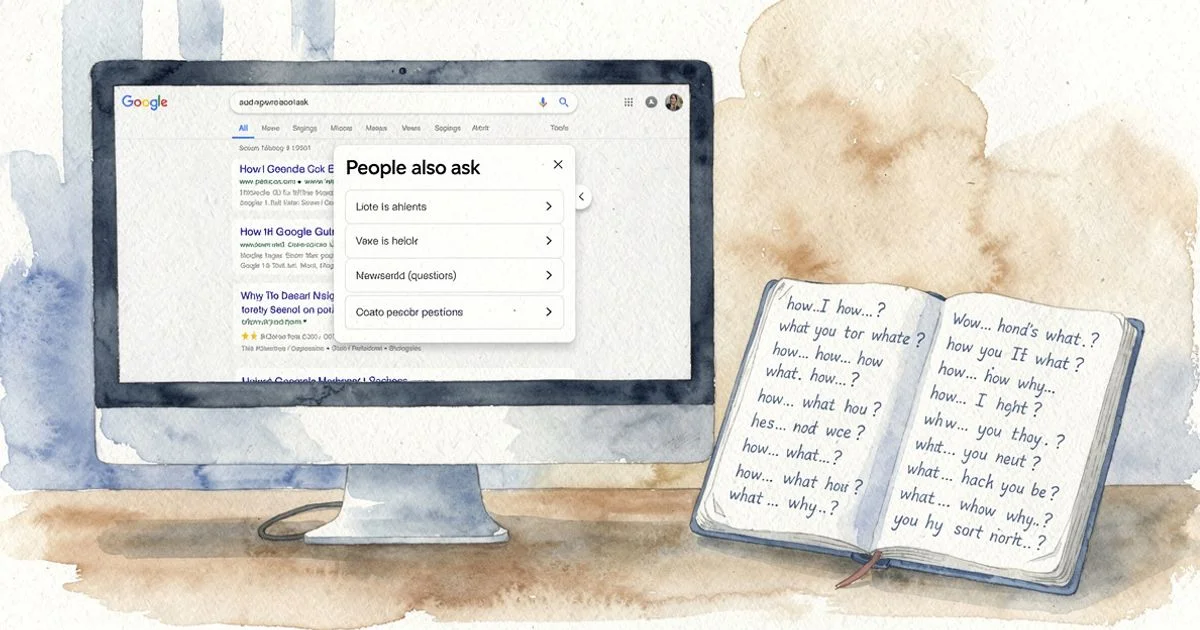
Pull real questions from PAA, Search Console and AI prompts
Start with questions people actually ask. Search your main topics in Google and note the People Also Ask boxes. Then open Google Search Console and filter queries that start with what, how, why or does. Those are real questions already sending you impressions.
Next, check what people ask AI tools about your category. Prompt research shows which questions trigger AI answers and which brands get named. Add questions from sales and support calls, since those carry the strongest buying intent.
Write one direct answer per question, then add proof
Open each answer with the direct reply in the first sentence. Then add one supporting detail, a source or a specific example. Keep it to two to four sentences so it reads well in a snippet.
Use plain words your buyers use. If you cite a number, name where it came from. For questions that need depth, link to a full guide so the FAQ stays short and the deeper page earns its own rank.
Add FAQPage schema and track visibility in Google and AI answers
Add FAQPage schema to label each question and answer clearly. Validate it with Google's Rich Results Test, and do not expect a visible rich result unless you run an authoritative government or health site.
Then track two kinds of visibility. Watch Google rankings and Search Console clicks for your question keywords. Separately, check whether ChatGPT, Gemini and AI Overviews cite your page. Rankings alone no longer tell you the full story.
FAQs
What is the 80/20 rule in SEO?
The 80/20 rule in SEO says roughly 80% of your results come from 20% of your work, such as a handful of pages, keywords or fixes. In practice, you find the pages and queries already driving traffic and improve those first. Only then do you chase new topics, because small gains on proven pages usually beat big bets on new ones.
Is SEO dead or evolving?
SEO is evolving, not dead. People still search Google every day, and AI answers in ChatGPT, Gemini and AI Overviews pull from pages that rank and answer questions clearly. The work now covers both Google rankings and getting cited in AI answers, so SEO is still relevant with AI, just broader.
What are the 3 C's of SEO?
The 3 C's of SEO are most often described as content, code and credibility. Content answers the searcher's question. Code is the technical SEO that lets Google crawl and index the page. Credibility comes from links, reviews and brand mentions that show others trust you.
How long does it take for SEO to work?
Google's own guidance says SEO usually takes four months to a year to show results. New sites and competitive keywords sit at the longer end, since high keyword difficulty means stronger rivals. Fixes to pages that already rank can move within weeks.
Do FAQ pages still help SEO?
Yes, though not because of rich results. Since 2023, Google shows FAQ rich results mainly for authoritative government and health sites. A good FAQ page still ranks for long-tail questions and gives AI tools short, quotable answers to cite.
Conclusion: answer the questions your buyers actually ask
Recap: questions are how people search and prompt
The most common SEO questions are simple: what it is, how it works, how long it takes, its three pillars and how it compares with paid ads. An FAQ page that answers those questions clearly helps you rank, win snippets and get cited in AI answers. The rich result is mostly gone, but the value of a clear answer is not.
Start with your top ten questions this week
Pick ten real questions from People Also Ask, Search Console and your sales calls. Write one direct answer for each, add a source where you can, and publish them on one page with FAQPage schema. Then check in a month whether Google and AI tools pick them up.
If you want to find the questions your buyers ask and turn them into answers that rank and get cited, Zivooo gives you keyword and AI prompt research, a content plan built from competitors, an article writer, a live optimization editor, and AI visibility tracking in ChatGPT and AI Overviews. It is a practical option for marketers and founders who want to track Google and AI answers for $10 a domain.
WRITTEN BY

Muntasir Rashid
Hello 👋 I’m Muntasir, founder of Zivooo and a content marketer with 20+ years of hands-on experience in marketing, growth, and building businesses.
I’ve spent the last two decades marketing my own ventures and helping clients grow through content, SEO, and digital marketing. Along the way, I’ve learned that the best strategies rarely come from theory, they come from testing, experimenting, failing, and figuring out what actually works.
Content marketing and growth are my forte. Here, I share practical insights, experiments, and lessons from the trenches covering SEO, GEO, AEO, AI search, and growth strategies for modern tech companies.
Keep learning, keep growing
We have more articles on similar topics to help grow your business.

SEO Keyword Usage: How to Place Keywords Without Stuffing
SEO keyword usage means placing one primary keyword in your URL, title, H1, and intro, then supporting it with variations. Learn how to do it without stuffing.


Why Is Content Marketing Important? How It Earns Customers
Content marketing is important because it builds trust, drives organic traffic, and generates 3x more leads at 62% less cost than traditional marketing.