[Case Study] I Asked AI 30 Times Which Content Optimization Tool Is Best

Surfer SEO was named in 24 of the 30 answers I collected, and it held the best average position of any tool at 1.2. In a category with no clear leader, the assistants agreed on one almost every time. If you sell a content optimization tool and you are not Surfer, that is the number to sit with.
What I found
- Surfer SEO appeared in 24 of 30 answers, more than any other tool, and held the best average position at 1.2.
- Clearscope came second, named in 22 of 30 answers, with an average position of 2.1.
- Independent sites made up 85% of the 319 citations, while vendors' own pages were just 12%.
- The pick changed in only 2 of the 10 repeat pairs, so asking again rarely moved the top answer here.
- The pages the answers quoted had a median length of 2,291 words, shorter than the pages Google ranked but the answers skipped.
- Across the run, 17 distinct brands were named, but 5 tools carried almost every answer.
Everyone assumes this category has no leader
Surfer, Clearscope, Frase, MarketMuse and NeuronWriter all compete hard on content optimization, and none is the obvious default. They also barely show up when you ask a generic SEO question. So I wanted to know a narrow thing: when a buyer asks an AI assistant which on-page content scorer to use for writing that ranks, which name comes back?
I expected a spread. Five close competitors with no clear winner should produce five different recommendations depending on how you phrase the question. That is not what happened, and the citation data underneath the answers is stranger than the answers themselves.
Surfer SEO led 24 of 30 answers, and held first place
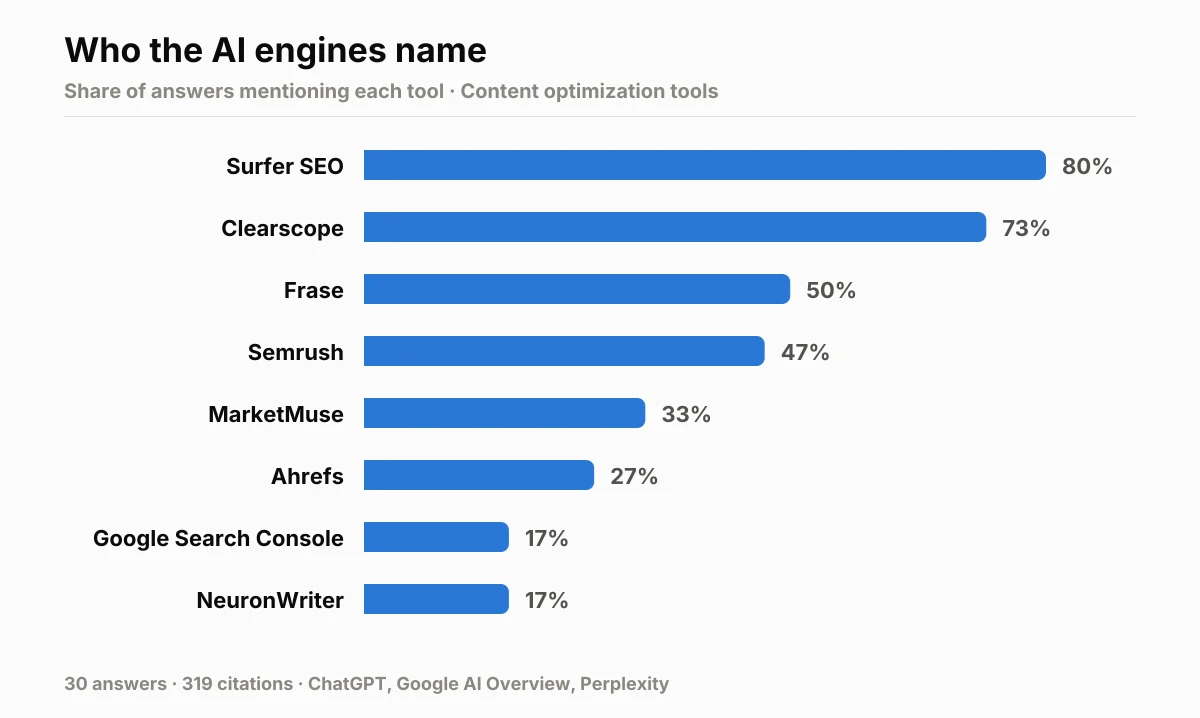
Across the 30 usable answers, Surfer SEO was the most named tool by a clear margin. It appeared in 24 of them and held the best average position at 1.2, meaning when it was named it was usually named first. Clearscope followed in 22 answers with an average position of 2.1. After those two the field thins fast.
| Tool | Answers named in (of 30) | Mention rate | Avg position |
|---|---|---|---|
| Surfer SEO | 24 | 80% | 1.2 |
| Clearscope | 22 | 73% | 2.1 |
| Frase | 15 | 50% | 3.7 |
| Semrush | 14 | 47% | 3.9 |
| MarketMuse | 10 | 33% | 3.3 |
| NeuronWriter | 5 | 17% | 5.2 |
The category I expected to be split had two names doing most of the work. Surfer and Clearscope together showed up in the large majority of answers. The other 15 brands, including the rest of the direct competitors, shared the leftovers.
Key takeaway: If you compete with Surfer or Clearscope in this category, treat their near-lock on AI answers as the baseline you are trying to break into, not a race you are already in.
Independent sites wrote 85% of what the engines quoted
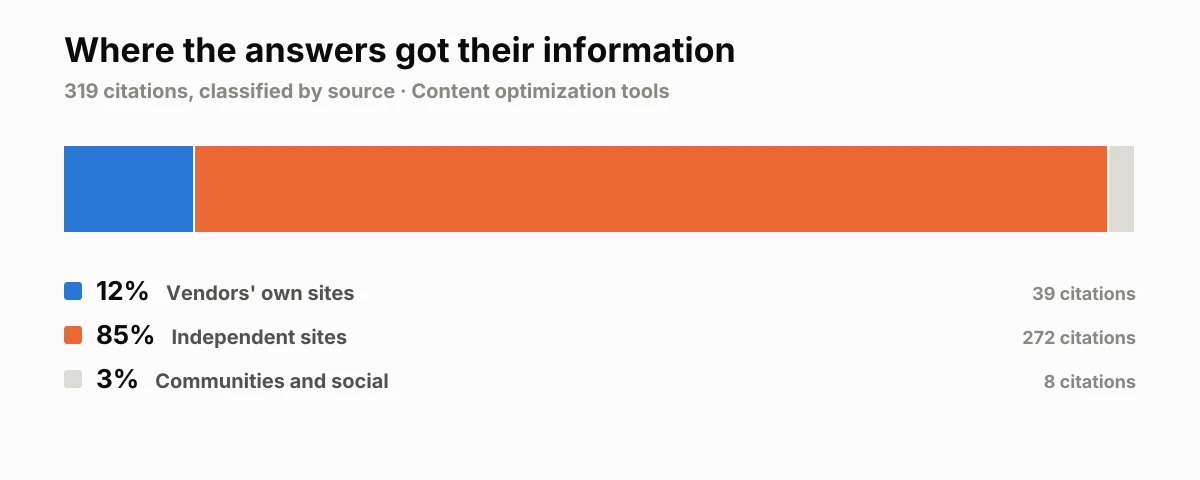
That explains part of why the answers agreed. When I looked at where the 319 citations came from, they were not coming from the vendors. Independent sites accounted for 85% of the 319 citations. Vendors' own pages were 12%. Community posts were 2% and social was 1%, and review sites contributed 0.
No single domain dominated either. The 319 citations spread across 99 unique domains, and 58 of those domains were cited only once or twice. The most cited source was onelittleweb.com at 18 citations, followed by blog.hubspot.com and semrush.com at 13 each. So the answers about these tools were largely built on third-party roundups and comparison posts, not on the tools' own marketing.
Key takeaway: Check which independent roundups name you and how, because in this category those pages were quoted far more than any vendor's own site.
The pages the answers skipped were longer than the ones they quoted
Here is the number that runs the wrong way. I crawled the pages the AI answers quoted and, separately, the pages Google ranked for the same questions that the answers did not quote. The quoted pages had a median length of 2,291 words. The ranked-but-skipped pages had a median of 3,356 words. The longer pages were the ones that got left out.
The full page score comparison is not statistically comparable on this run: only 6 of 9 control pages could be scored, against 68 of 80 on the quoted side (the rest blocked the crawler or returned nothing). So I will not lean on the factor-by-factor scores. But the word counts are worth stating plainly, because they cut against the instinct that a more thorough, longer guide is what gets picked up.
Key takeaway: Before you commission a very long guide to win AI citations in this category, test shorter, because here the quoted pages ran shorter than the ones that were skipped.
Asking again changed the pick in only 2 of 10 pairs
The last thing I checked was whether the answers were stable. I asked the same question to the same engine more than once and watched whether the top pick moved. It changed in only 2 of the 10 repeat pairs. On this category, the AI answers were mostly repeatable, which is unusual in my experience with other categories.
Both changes involved a swap near the top rather than a jump to an unknown tool. In one Perplexity pair the pick moved between Clearscope and Surfer. In one ChatGPT pair it moved between Surfer SEO and Semrush. The rest returned the same name each time.
Key takeaway: In a category this stable you can trust a single scan more than usual, but still run each question at least twice so you catch the pairs that do move.
What to do about it
Get named in the independent roundups, not just your own blog
Spend your effort on the third-party comparison pages that the answers actually quoted. On this run, independent sites were 85% of the 319 citations and vendors' own pages were only 12%. The most cited domains were roundups like onelittleweb.com, blog.hubspot.com and rankability.com, not tool homepages. This is one category on one day, so it shows correlation, not that a placement will get you named. But it points your outreach at the pages doing the work.
Test shorter pages against your longest ones
Do not assume the longest, most complete guide wins the citation. Here the quoted pages ran to a median of 2,291 words while the ranked pages the answers skipped ran to 3,356. That is a difference in what got quoted, not proof that length caused it, and the control sample was small at 6 scored pages. Still, it is worth publishing a tighter version and watching whether it gets picked up.
Ask each question at least twice before you trust a ranking
Run every question more than once and log the spread. On this run the pick changed in 2 of the 10 repeat pairs, which is low, but both changes were near the top of the list where it matters most. This is one category, so your own may be noisier. Repeating is how you find out instead of guessing.
Track being named and placing first as two separate numbers
Watch how often you are named and where you land, not one figure. Surfer led both here, named in 24 of 30 answers at an average position of 1.2. But Semrush Writing Assistant held a strong average position of 2 while being named in only 2 answers, so the two measures can diverge. This is a snapshot, so treat it as a baseline to re-measure, not a verdict.
How this was measured
On 2026-09-15 I put 4 buying questions to three engines: Google AI Overview, Perplexity and ChatGPT. I asked each question 3 times per engine, for 36 attempted scans. 30 came back usable. All 3 engines answered.
The failures were all on Google. Google AI Overview was asked 12 times and returned 6 usable answers, with 6 empty responses on the content optimization, on-page scoring and keyword questions. Perplexity and ChatGPT each returned 12 usable answers from 12 attempts. Because of that, the AI Overview trigger rate of 100% is over the 6 Google scans I could read, not over the 12 times Google was asked. "Every time I asked Google" would be false here. The questions were: best content optimization tool for SEO, best tool for writing content that ranks on Google, best on-page SEO content scoring tool, and which tool to use to optimize articles for keywords. The run cost $0.31 and took about 8 minutes.
What this sample cannot show
This is one category, content optimization tools, scanned on a single day. 4 questions and 30 usable answers is enough to see a pattern and not enough to call it a trend. Google AI Overview lost 6 of its 12 attempts, so its weight in the results is thinner than the other two engines. The page score comparison is not statistically comparable, with only 6 control pages scored, so I have reported the word counts and left the factor scores out. Everything here is a description of what came back, not an explanation of why the engines chose it. Treat it as a baseline to re-run, not a law.
To answer this question for your own brand you would have to ask the buying questions yourself, across ChatGPT, Google AI Overview and Perplexity, and repeat each one so the variance is visible: that is what Zivooo does, tracking which tools the assistants name for a category over time. If you are a content optimization tool watching Surfer and Clearscope take most of the answers, that repeated measurement is how you tell whether your own name is moving.
Author Details

Muntasir Rashid
Hello 👋 I’m Muntasir, founder of Zivooo and a content marketer with 20+ years of hands-on experience in marketing, growth, and building businesses.
I’ve spent the last two decades marketing my own ventures and helping clients grow through content, SEO, and digital marketing. Along the way, I’ve learned that the best strategies rarely come from theory, they come from testing, experimenting, failing, and figuring out what actually works.
Content marketing and growth are my forte. Here, I share practical insights, experiments, and lessons from the trenches covering SEO, GEO, AEO, AI search, and growth strategies for modern tech companies.
Keep learning, keep growing
We have more articles on similar topics to help grow your business.

9 AI Visibility Tracking Tools to Monitor Brand Mentions
AI visibility tracking tools monitor how your brand appears in ChatGPT, Perplexity, Gemini, and Google AI Overviews.


Search Engine Optimization & Machine Learning, Explained Simply
Search engine optimization machine learning explains how Google uses RankBrain and BERT to rank by intent, not keywords. Learn what this means for your traffic.