[Case Study] Interesting Findings When I Asked AI 34 Times for the Best Website Builder.

I asked three AI assistants which AI website builder to use, five questions asked three times each, and collected 34 usable answers. Wix showed up in 29 of them, the newer AI-first brands like Durable and 10Web trailed well behind. If you sell in this category and you assumed the assistants would reward whoever markets AI hardest, this run says otherwise.
What I found
- Wix appeared in 29 of the 34 usable answers, more than any other builder and more than the AI-first newcomers.
- Framer came second, appearing in 20 answers, the only AI-first brand near the top.
- Wix held the best average position at 1.8, ahead of Framer at 2.1.
- Asking the same question again changed the top pick in 7 of the 11 repeat pairs.
- Independent sites made up 247 of the 390 citations, nearly two-thirds of the sources.
- Google AI Overview returned a readable answer only 4 times out of 15 attempts.
What I expected the AI-first brands to do
Framer, Durable, Hostinger AI, 10Web and Mixo are a distinct new shortlist of builders that generate a whole site from a prompt. The question I set out to answer was simple: which builders do the AI assistants themselves recommend when you ask them?
Going in, I expected the AI-first tools to do well, because they market the AI angle harder than anyone. The honest hypothesis was that the assistants might favor whoever waves the AI flag loudest. This run broke that assumption on the first finding.
Wix appeared in 29 of 34 answers, the newcomers trailed
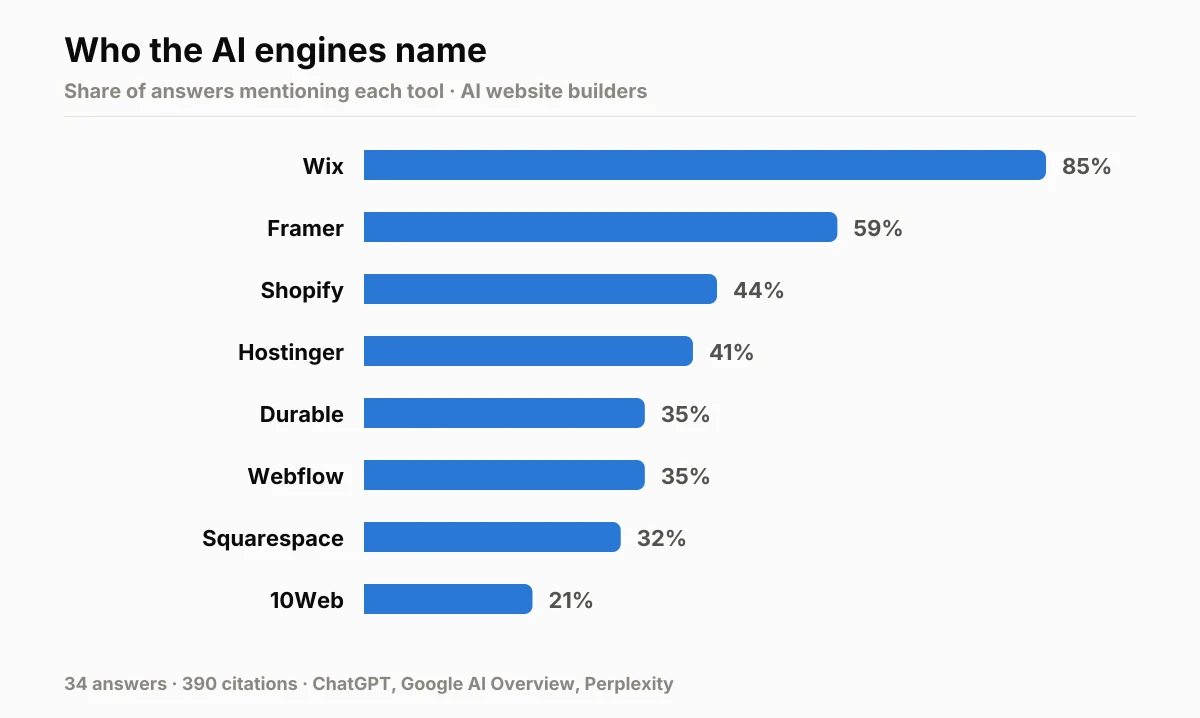
Wix, a builder that predates this whole AI category, appeared in 29 of the 34 usable answers, an 85% mention rate. It was recommended (not just mentioned in passing) in 26 of them. That is the clearest result in the run.
Framer came second, in 20 answers, a 59% mention rate. Framer is genuinely AI-first, so this is the newcomer holding its own. After that the ranking drops off. Shopify appeared in 15 answers, Hostinger in 14, and the two purpose-built AI generators I expected to lead sat lower: Durable in 12 answers, 10Web in just 7.
Position tells the same story. Wix held the best average position at 1.8, Framer at 2.1, and 10Web trailed at 4.3. Across all three engines, 44 distinct brands were named at least once, so the field was wide, but the top of it was old.
Key takeaway: If you sell an AI-first builder, check whether the assistants actually name you before you assume the AI label is doing the work, because in this run it was not.
Asking twice changed the top pick 7 times in 11
That Wix lead looks solid until you ask the same question twice. I ran 11 repeat pairs, one question put to one engine and then asked again, and the top pick changed in 7 of them.
Some of that churn is just naming: ChatGPT flipped between "Wix" and "Wix AI" on the same question. But some is a real swap. On "AI website builders that generate a full site from a prompt?", Perplexity picked Webflow AI twice, then Wix. On "Fastest AI website generator for a small business?", Perplexity picked Durable once, then Hostinger twice. Google AI Overview was the one steady surface I could read, picking Wix all three times on the one question it answered.
So the headline that Wix leads is true across the run as a whole, and unstable inside a single question. Both things are measurements, and the reader who checks their own name once will not see this.
Key takeaway: Ask each question at least three times before you trust a ranking, because in this run the top pick moved in more than half of the repeats.
Independent sites wrote 247 of the 390 citations
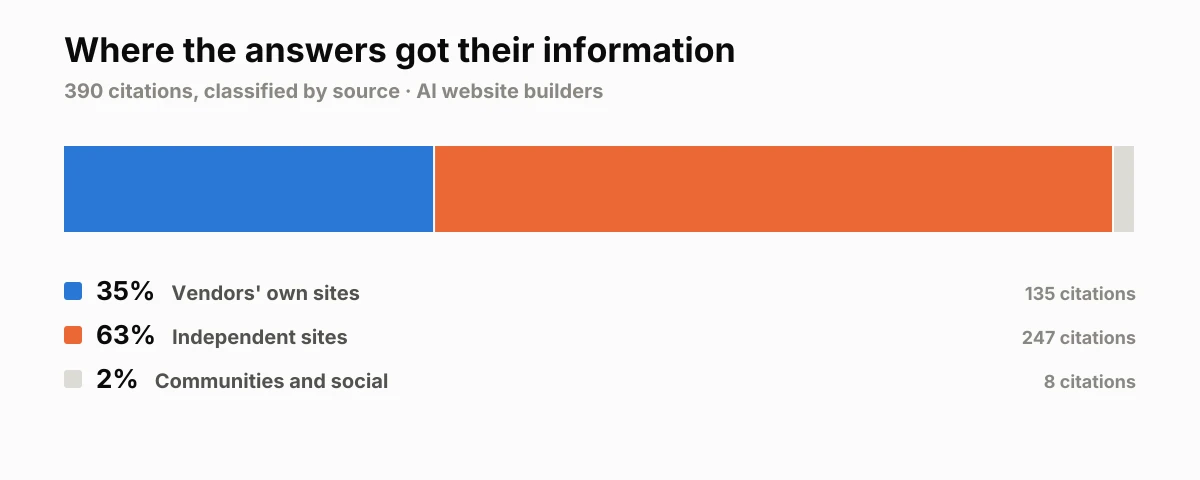
So where do the answers get their material? I pulled 390 citations across 110 unique domains. Independent sites (roundups, tech press, blogs) accounted for 247 of them, 63%. Vendors' own sites accounted for 135, 35%. Review sites and community forums were almost absent: 0 review citations, 1 community citation, and 7 from social.
The single most-cited domain was framer.com, at 26 citations, a vendor site. Techradar.com, an independent, came next at 17. Wix's own wix.com and zapier.com tied at 15 each. So the brand that appeared in the most answers (Wix) and the brand whose own pages were cited most (Framer) are not the same brand. Those are two measurements sitting next to each other, and they are worth watching separately.
The tail is long: 81 domains sat in the long tail and 37 of them were cited only once or twice. There is no single source these answers lean on.
Key takeaway: Track the independent roundups in your category as closely as your own pages, because in this run they carried nearly two-thirds of the citations.
Google gave a readable answer only 4 times in 15
One caveat sits under every number above, and it is about Google. I asked Google AI Overview 15 times and got a readable answer back only 4 times. The other 11 attempts either returned an empty response or the surface was unavailable that run.
Of the 4 Google scans I could read, all 4 carried an AI Overview, a 100% trigger rate over what came back. That is not "every time I asked Google", it is "every time I could read Google". ChatGPT and Perplexity each answered all 15 times. So most of what this run measures is those two engines, and the Google slice is thin enough that I would not lean on it alone.
Key takeaway: Weight ChatGPT and Perplexity heaviest when you read this, because Google returned usable data only 4 times out of 15 here.
What to do about it
Measure whether AI assistants name you, not whether you market AI
Go ask ChatGPT and Perplexity your own category question and log which brands come back. In this run the AI-first builders I expected to lead did not: Durable appeared in 12 answers and 10Web in 7, while legacy Wix appeared in 29. The AI label did not track with getting named. This is one category on one day, so treat it as a prompt to measure your own position, not as proof the pattern holds everywhere.
Ask each question three times before you trust the ranking
Run every buying question at least three times per engine and record the spread. The top pick changed in 7 of my 11 repeat pairs, including real swaps like Perplexity moving from Durable to Hostinger on the same question. A single ask would have shown you a stable winner that is not stable. This is a small sample of pairs, so read it as a reason to repeat, not as a fixed churn rate.
Track the independent roundups, not just your own site
Find the roundup articles the assistants cite in your category and watch them the way you watch your own pages. Independent sites carried 247 of the 390 citations here, and techradar.com alone was cited 17 times. Vendor pages still mattered (framer.com led all domains at 26), but the bulk came from third parties. One category, one day, so confirm the mix in yours before acting.
How this was measured
On 2026-09-16 I asked five buying questions about AI website builders: "Best AI website builder?", "What's the best tool to build a website with AI?", "AI website builders that generate a full site from a prompt?", "I want a site built automatically without designing it myself, what should I use?", and "Fastest AI website generator for a small business?"
Each question went to Google AI Overview, ChatGPT and Perplexity, three runs each, so 45 scans attempted. Of those, 34 came back usable. Every rate in this article is over those 34, never over the 45 asked. ChatGPT returned all 15, Perplexity returned all 15, and Google AI Overview returned only 4 of 15: four empty responses on two questions, and seven scans skipped because the surface was unavailable that run. The whole run took about 6 minutes and cost $0.35.
What this sample cannot show
This is one category (AI website builders) scanned on one day, with five questions and 34 usable answers. That is enough to see a pattern and not enough to call it a law. The Google slice is especially thin, only 4 readable answers, so most of the signal is ChatGPT and Perplexity. I recorded what the assistants named and what they cited, not why they chose it, and I make no claim about which builder is actually better. Ask again next month and the numbers will move.
To answer this for your own brand you would have to ask each category question across ChatGPT, Google AI Overview and Perplexity, repeated enough times to see the variance, then track which tools get named and where they place. Zivooo runs exactly that on a schedule. If you are watching an AI-first product try to win a category an older brand already holds, it is built for that watch.
Author Details

Muntasir Rashid
Hello 👋 I’m Muntasir, founder of Zivooo and a content marketer with 20+ years of hands-on experience in marketing, growth, and building businesses.
I’ve spent the last two decades marketing my own ventures and helping clients grow through content, SEO, and digital marketing. Along the way, I’ve learned that the best strategies rarely come from theory, they come from testing, experimenting, failing, and figuring out what actually works.
Content marketing and growth are my forte. Here, I share practical insights, experiments, and lessons from the trenches covering SEO, GEO, AEO, AI search, and growth strategies for modern tech companies.
Keep learning, keep growing
We have more articles on similar topics to help grow your business.

7+ Best AI Optimization Tools for Visibility, Compared
What's the best AI optimization tool for visibility? Compare 7+ tools like Profound, OtterlyAI, and Zivooo to find the right fit for monitoring or execution.

7+ Best AI SEO Tools Compared for Small Tech Teams
SEO AI tools compared for small tech teams: see how Semrush, Surfer, Ahrefs, and managed services like Zivooo differ so you can pick the right fit fast.