SEO vs SEM: What Is the Real Difference?
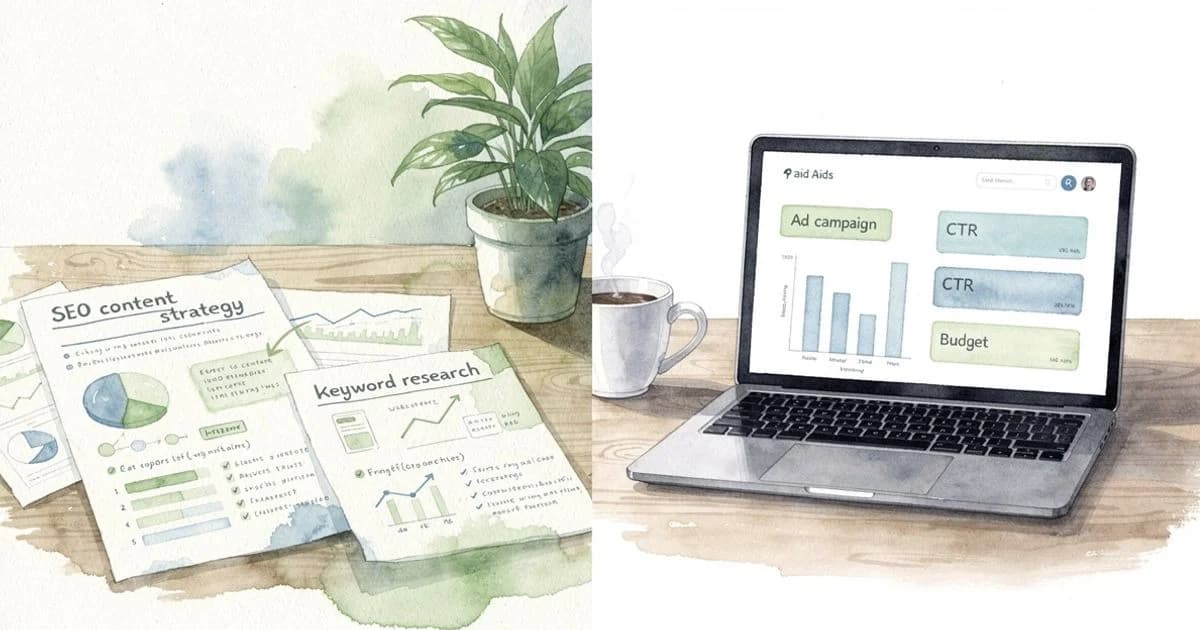
SEO and SEM are the two main ways to get your business found on search engines, but they work in opposite ways. SEO (search engine optimization) is the practice of earning unpaid, organic rankings by improving your content, site speed, and backlinks. SEM (search engine marketing) is the broader practice of increasing visibility through paid search ads, and many marketers use it to mean pay-per-click (PPC) specifically.
The core difference between SEO and SEM is traffic type and timing. SEO builds durable organic traffic that keeps working after you stop paying. SEM buys instant visibility that disappears the moment your budget runs out. SEO typically takes 3 months to 2 years to mature, whereas paid ads can appear within hours.
SEO vs SEM in one minute
Short on time? Here is the SEO vs SEM summary in one table. Scan it, then dig into the sections that matter for your situation.
| Factor | SEO | SEM (paid search) |
|---|---|---|
| Traffic type | Organic (unpaid) | Paid (sponsored) |
| Cost per click | No per-click fee | You pay for each click |
| Time to results | 3 months to 2 years | Hours to days |
| When you stop | Traffic continues | Traffic stops |
| Position on SERP | Below the ads | Top of the page |
| Best for | Compounding growth | Fast, targeted wins |
That is the SEO vs SEM difference at a glance. Now let us define each term as its own thing.
What is SEO and SEM?
According to the American Marketing Association, SEO and SEM both aim to increase a website's visibility on search engine results pages (SERPs) but work through fundamentally different methods: unpaid organic versus paid sponsored placement.
What SEO means
SEO is the practice of improving a website's visibility in the organic search results. You do not pay Google for these rankings. Instead, you earn them by signaling relevance and authority.
SEO breaks into a few core areas:
- On-page SEO: your content, titles, headings, and internal links.
- Technical SEO: site speed, crawlability, mobile usability, and clean URL structure.
- Off-page SEO: backlinks and mentions that build trust.
- Keyword research: finding the terms your buyers actually type.
Good on page seo starts with matching search intent. If someone searches "how to," they want a guide, not a product page. Technical seo keeps Google able to crawl and index your pages fast.
What SEM means
SEM refers to search engine marketing, the paid route to the same search results page. You bid on keywords, and your ad shows at the top when someone searches. You pay each time they click.
The engine behind SEM is PPC, pay-per-click. Google Ads is the biggest platform. Your SEM overview should cover ad copy, bidding, targeting, and landing page quality. Strong SEM lets you appear for a keyword today, even with a brand-new website.
Where the two overlap
SEO and SEM share the same goal: more visibility on the SERP. They also share inputs. Both rely on keyword research. Both need relevant content. Both improve when your landing pages load fast and read clearly.
Confusingly, "SEM" is sometimes used as an umbrella term that includes SEO plus paid search. Most marketers today use SEM to mean paid search specifically. We will use that meaning here.
Why the difference matters for your growth
Understanding the differences between SEO and SEM changes where you put your budget. The wrong choice wastes months or burns cash. Here are the three factors that matter most.
Cost: free clicks vs paid clicks
SEO clicks are free in the sense that you pay no per-click fee. You invest upfront in content and technical work. Over time, the cost per visitor drops as traffic compounds.
SEM charges you for every click. The moment you pause the campaign, the clicks stop. For competitive keywords, bids can get expensive fast. Paid search is a faucet: open it, water flows; close it, it stops.
Time to results
This is the sharpest difference between SEO and SEM. According to Semrush, SEO can take anywhere from 3 months to over 2 years to build the authority needed to rank. Paid search ads appear almost immediately after a campaign launches.
So SEO is a long game. You plant content now and harvest traffic later. SEM is instant. If you launch today, you can have clicks today. That timing gap drives most early-stage decisions.
What happens when you stop
Stop paying for SEM, and your visibility vanishes within hours. There is no residual value. The ad simply stops showing.
Stop active SEO work, and your rankings often hold for months. Content you published a year ago can still bring traffic. This durability is why many founders treat SEO as an asset and paid search as an expense.
How SEO and SEM actually work
To choose well, you need to know the mechanics. Here is how each engine turns effort into visibility on the search engine results page.
How SEO earns organic rankings
Search engines work in three steps. First, crawling: Google's bots discover your pages by following links. Second, indexing: Google stores and understands the page content. Third, ranking: Google orders pages by relevance and quality for each query.
SEO ranking factors include content relevance, backlinks, page experience, and topical depth. You influence them with keyword research, strong on-page content, and technical fixes. Key SEO KPIs are organic traffic, keyword rankings, and conversions from organic visitors.
Search intent sits at the center. Keyword types fall into informational, navigational, commercial, and transactional. Match your page to the intent behind the keyword, and ranking gets far easier.
How SEM wins the ad auction
Google runs an auction every time someone searches. You do not simply buy the top spot. Google's system ranks ads by Ad Rank, which combines your bid with Quality Score.
Quality Score rewards relevant ad copy, expected click-through rate, and a strong landing page. So a smaller budget with sharper relevance can beat a bigger, sloppier one. The role of PPC is to buy qualified clicks at a price that still returns a profit.
How they feed each other
SEO and SEM are not rivals. Run them together and each gets stronger. Paid search gives you fast keyword data. You see which terms convert, then build SEO content around the winners.
Meanwhile, SEO content improves your landing page quality, which lifts Quality Score and lowers ad costs. Owning both the paid and organic slots for a keyword also doubles your SERP presence. That combined footprint builds trust.
Examples: SEO vs SEM in the real world
Abstract definitions only go so far. Here are three scenarios a founder can map to their own business.
A SaaS product launch
You are launching a new tool next week. Nobody has heard of you, and your website has no authority. SEO will not rank in time. You start with SEM to buy visibility on high-intent keywords immediately.
While paid search drives early signups, you begin publishing content. Three to six months in, organic traffic starts to arrive. Now you reduce paid spend on the terms you rank for organically and keep ads for the rest.
A seasonal promotion
A retailer runs a holiday sale that lasts two weeks. There is no time for SEO to mature. SEM is the clear fit. You launch ads on gift-related keywords, capture demand during the window, and pause spend when the sale ends.
SEO still helps indirectly. Evergreen gift guides you published earlier can rank every season. Those pages become compounding assets that work alongside the paid push each year.
A long-term content engine
A B2B company wants a steady pipeline of leads without rising ad bills. This is SEO territory. They do keyword research, map topics by search intent, and publish consistently.
The payoff is slow but durable. After a year, their content library pulls in organic traffic daily, at a cost per lead far below paid search. This is the compounding case that makes SEO worth the wait.
SEO vs SEM vs PPC vs GEO: clearing up the confusion
These acronyms get mixed up constantly. Here are the key differences, defined cleanly, so you can use each term correctly.
SEM vs PPC
SEM is the broader category: marketing on search engines through paid placement. PPC is the pricing model inside it, where you pay per click. In everyday use, people treat SEM and PPC as the same thing on Google.
The small distinction: PPC also exists outside search, like on social platforms. SEM, strictly, means paid search. For most founders, Google Ads is both your SEM and your PPC.
SEO vs GEO (getting cited by AI)
GEO is generative engine optimization: getting your brand cited inside AI answers from tools like ChatGPT and Perplexity. AI systems pull from well-structured, fact-checkable content, so the fundamentals of SEO now feed GEO directly.
The shift is where the answer appears. Classic SEO fought for a spot on Google's results page. GEO fights to be the source an AI quotes. Topical depth, clear structure, and accurate data help AI systems trust and cite you.
As of 2026, many buyers start research inside an AI chat, not a search box. That is why strong SEO plus GEO now beats either one alone. Taking action on both widens where you get found.
What to do next: which one should you invest in?
The right call depends on your timeline and budget. Use these two rules to decide fast.
If you have time but little budget
Start with SEO. You trade time for durable traffic. Begin with keyword research to find low-competition terms your buyers search. Fix the big technical SEO issues so Google can crawl you.
Then publish content that matches search intent. Build backlinks steadily. Prioritize mobile-friendly pages, since Google's mobile-first indexing rewards them. The results arrive slowly, then compound.
If you need traffic this week
Start with SEM. Paid search buys immediate visibility for a launch or promotion. Set a small daily budget, target high-intent keywords, and point ads at a clean landing page.
The smart move is to run both. Use a small paid test to learn what converts while you build the organic engine in parallel. That way you get traffic now and lower-cost traffic later.
FAQs
What is the difference between SEM and SEO?
SEO earns unpaid, organic rankings by improving your content, technical setup, and backlinks. SEM increases visibility through paid search ads, usually PPC. In short, SEO is the slow, durable game and SEM is the fast, pay-to-play one. SEM is also often used as an umbrella term that includes SEO plus paid search.
Is Google Ads SEO or SEM?
Google Ads is SEM, specifically the paid search (PPC) side of it. You bid on keywords and pay each time someone clicks your ad. SEO, by contrast, involves no per-click fee. You invest in content and site quality to rank in the free organic results below the ads.
What does SEO and SEM stand for?
SEO stands for search engine optimization. SEM stands for search engine marketing. Both are about getting found on search engines, but SEO focuses on organic results and SEM centers on paid results (and sometimes covers both).
Is SEO dead now with AI?
No. AI tools like ChatGPT and Perplexity still pull answers from well-optimized, fact-checkable content, so the fundamentals of SEO now feed into GEO (generative engine optimization). What has changed is that you need your brand cited inside AI answers, not just ranked on Google. SEO is evolving, not dying.
Should a small company do SEO or SEM first?
If you need traffic this week for a launch or promotion, start with SEM to buy immediate visibility. If you want compounding, lower-cost traffic over time, start building SEO now because it takes months to pay off. Most growing teams run a small paid test while they build the organic engine in parallel.
Conclusion
The SEO vs SEM choice is not really either-or. SEM buys you speed; SEO builds you an asset. Use paid search to validate keywords and capture urgent demand. Use SEO, and now GEO, to earn durable traffic and AI citations that keep paying off.
Match the tool to your timeline. If you have months and patience, invest in organic. If you need clicks this week, run ads. The strongest teams do both, letting paid data sharpen the organic engine over time.
If you want to build the durable, compounding organic side of this equation, Zivooo gives you keyword research, research-backed article drafts, a live editor scoring 40+ SEO, GEO, and AEO factors, custom AI images, and AI visibility tracking in ChatGPT and Google AI Overviews. It is a self-serve, pay-as-you-go SEO, GEO, and AEO platform for founders and small teams who want to grow organic traffic from Google and AI answers.
Author Details

Muntasir Rashid
Hello 👋 I’m Muntasir, founder of Zivooo and a content marketer with 20+ years of hands-on experience in marketing, growth, and building businesses.
I’ve spent the last two decades marketing my own ventures and helping clients grow through content, SEO, and digital marketing. Along the way, I’ve learned that the best strategies rarely come from theory, they come from testing, experimenting, failing, and figuring out what actually works.
Content marketing and growth are my forte. Here, I share practical insights, experiments, and lessons from the trenches covering SEO, GEO, AEO, AI search, and growth strategies for modern tech companies.
Keep learning, keep growing
We have more articles on similar topics to help grow your business.

What Is an SEO Title and How Do You Write One?
An SEO title is the clickable headline Google shows in search results.


SEO Fundamentals: How Search Engines Find and Rank You
SEO fundamentals cover four core pillars: keyword research, on-page SEO, technical SEO, and off-page SEO.